Context Engineering: The Next Evolution Beyond DevOps
The Era of AI Demands a New Operating Philosophy
Every major corporate revolution begins the same way: a set of best practices, a few tools, and a promise of transformation.
DevOps started that way. So did Agile. So did Cloud.
But each time, 80% of the Fortune 500 missed the point. They adopted the tools, not the mindset.
They automated pipelines without aligning outcomes.
They measured deploys instead of value.
They confused motion with progress.
Now AI is here, and it’s about to happen again.
OutcomeOps: The Culture of Augmented Outcomes
OutcomeOps is the cultural evolution that re-centers the enterprise around results, not rituals.
It asks a simple but uncomfortable question:
Are we delivering outcomes that matter—or just producing outputs that look impressive?
Where DevOps unified development and operations through automation, OutcomeOps unifies human cognition and machine intelligence through augmentation.
It’s not about speed—it’s about alignment.
Not just “move fast,” but move effectively.
An OutcomeOps organization measures success by the clarity of its outcomes and the velocity of its learning loops. It turns tools, data, and AI into partners—not shortcuts—in achieving those outcomes.
Context Engineering: The “How” Behind the Philosophy
If OutcomeOps is the culture shift, Context Engineering is the engineering discipline that makes it real.
Context Engineering is the craft of designing the environment in which AI thinks—the knowledge, rules, and context that determine its effectiveness.
It’s how teams build LLM-aware systems that don’t just generate words, but generate reliable reasoning.
At its core, Context Engineering answers this question:
How do we give AI the right information, at the right time, in the right form, to make the right decisions?
The answer is not prompts. It’s systems.
Systems that:
- •Version and retrieve architectural decisions, standards, and code samples
- •Provide structured grounding for LLMs to reason within enterprise guardrails
- •Enable feedback loops where engineers and AI co-review code, enforce standards, and learn together
- •Create a persistent memory of decisions and trade-offs that improves with every interaction
An AI-assisted engineering platform—one that lives inside tools like Teams, GitLab, and Jira—sits at the foundation of Context Engineering.
– It operationalizes knowledge.
– It embeds augmentation into daily work.
– It transforms every question like “why did my build fail?” into a learning moment backed by institutional intelligence.
This is how Context Engineering works:
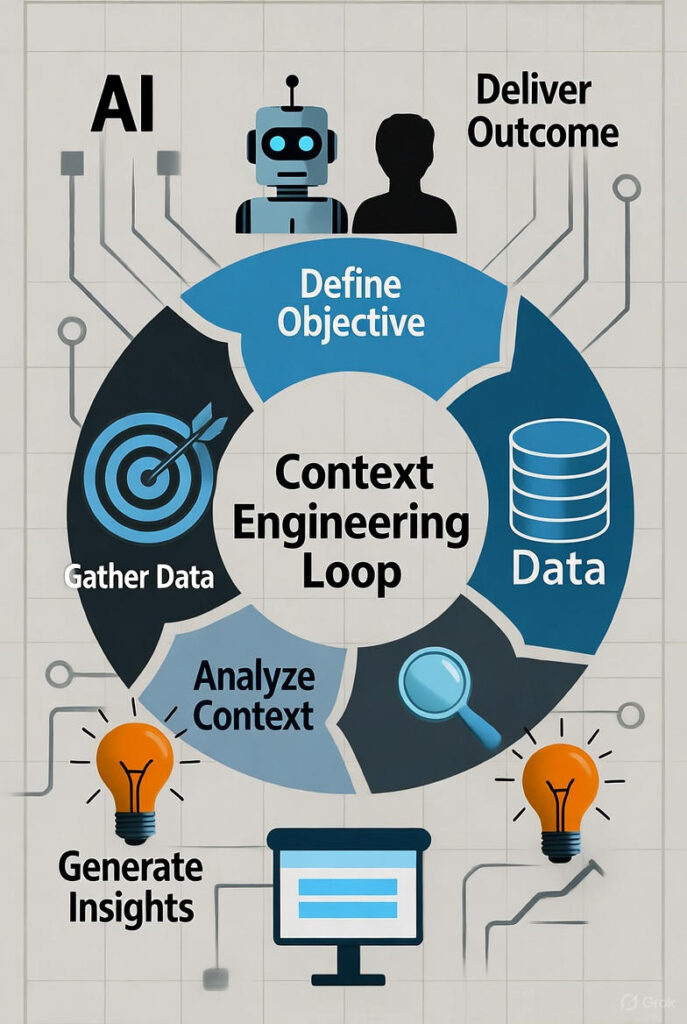
It’s a system that learns and delivers.
From DevOps to OutcomeOps: Culture Meets Craft
DevOps gave us automation.
OutcomeOps gives us augmentation.
In the same way CI/CD pipelines transformed how we deliver code, Context Engineering transforms how we deliver cognition. It’s continuous integration and delivery not of software, but of intelligence.
Here’s the shift in focus:
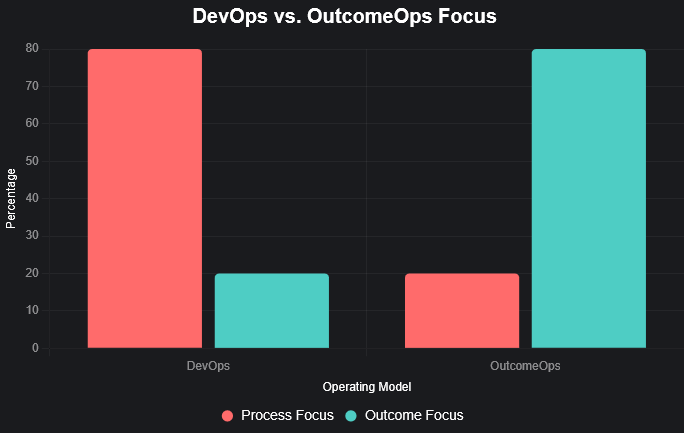
Chart showing shift in focus
OutcomeOps redefines success around results, not rituals.
Why 80% of the Fortune 500 Will Miss It Again
Because they’ll repeat the same mistake.
They’ll buy a product instead of building a philosophy.
They’ll hire AI engineers but never teach leaders how to think in systems.
They’ll plug LLMs into old processes instead of redesigning the processes around outcomes.
They’ll measure AI usage, not AI-driven impact.
Just like they once measured deploy frequency without asking whether those deploys created value.
The companies that get it will realize this:
OutcomeOps is not about adopting AI faster it’s about aligning intelligence, human and machine, toward the outcomes that actually matter.
Those who master that loop—Prompt → Inspect → Refine → Align → Ship—will out-learn and out-execute everyone else.
The Future Operating Model
OutcomeOps is the culture. Context Engineering is the craft.
Together, they form the blueprint for enterprises that evolve, learn, and deliver in real time. We proved this when we refactored a 1,348-line Lambda using Context Engineering in under an hour, and again when 3 ADRs transformed AI-generated code on Spring PetClinic.
The future of engineering isn’t about shipping code faster.
It’s about teaching organizations to think in feedback loops—with AI as a co-engineer, not a vending machine. The engineers who embrace this shift are becoming Outcome Engineers — measuring revenue, not deployments.
The companies that understand this will redefine speed, quality, and intelligence itself.
The rest will keep automating their way to irrelevance.
OutcomeOps: The Future of AI Engineering
Opens Substack in a new tab to confirm. No spam — unsubscribe anytime.
Enterprise Implementation
The Context Engineering methodology described in this post is open source. The production platform with autonomous agents, fully private air-gapped deployment, and compliance features is available via enterprise engagements.
Learn More